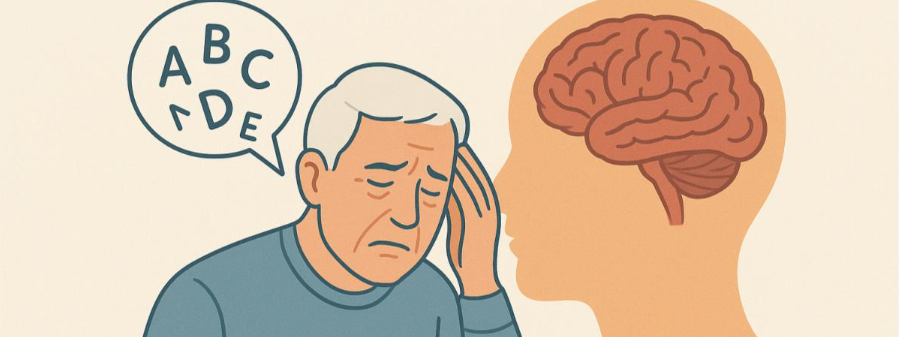
PPA & Post-stroke Aphasia Symposium: Advances in Clinical Neuroscience
15 & 16 December 2025
Brussels, Belgium
Welcome & Registration
Opening remarks
Platform session 1: Connected speech analysis. Chair: Maaike Vandermosten
Artificial Intelligence to Detect Chronic Post-Stroke Aphasia From Natural Speech (A5). Mara Barberis
Compound Processing in Primary Progressive Aphasia (A6). Christina Manouilidou
Detecting Primary Progressive Aphasia and Its Variants via Digital Analysis of Connected Speech (A7). Petronilla Battista
Word Surprisal in Frontotemporal Lobar Degeneration and Parkinson’s Disease Reflects Changes in Syntax and Lexical Content of Speech (A8). Rosie Coppieters
Break
Keynote 1: Primary Progressive Aphasia: a Journey Through Language, Neuroimaging, Cellular and Genetic Signatures of a Fascinating Clinical Syndrome (A1)
Lunch + Poster Session (see p.5)
Platform session 2: Neural correlates of speech and language. Chair: Rose Bruffaerts
From Words to Discourse: Investigating the Cognitive and Neural Overlap Between Picture Naming and Connected Speech in PPA (A9). Francesca Conca
EEG-Based Neural Assessment of Post-Stroke Aphasia (A10). Andi Smet
Cortical Speech Envelope Tracking Reflects Lesion-Symptom Profiles in Post-Stroke Aphasia (A11). Guangting Mai (presenter: Holly Robson)
Lesion Correlates of Speech Rhythm Insensitivity in Post-Stroke Aphasia (A12). Zhouyiting Zhao
Plenary talk: Neuromodulation in PPA (A3). Silke Coemans
Closing remarks
End
Welcome & Registration
Platform session 3: Crosslinguistic Investigation of PPA. Chair: Stefanie Keulen
Adapting the Mini-Linguistic State Examination (MLSE) to Norwegian (A13). Ingeborg Sophie Ribu
The Dutch Mini-Linguistic State Examination (MLSE-NL): Preliminary Findings in Primary Progressive Aphasia (A14). Rose Bruffaerts
Quantitative Assessment of Agrammatism in Turkish Speaking Patients with Primary Progressive Aphasia (A15). Mustafa Seçkin
A Neuro-Psycholinguistic Study of Primary Progressive Aphasia in Arabic (A16). Mohamed Taiebine
Characterizing Speech and Language Impairments in Primary Progressive Aphasia: Cross-Linguistic Insights From English, Chinese, and Italian (A17). Gaia Chiara Santi
Break
Keynote 2: Development and Validation of the Mini-Linguistic State Examination (A2)
Lunch + Poster session (see p.5)
Platform session 4: Diagnostic Assessment and Therapy. Chair: Miet De Letter
Neuroplasticity of Language Networks in Aphasia [NeuroLap]: an Exploratory Study Towards Advanced Diagnosis and Rehabilitation (A18). Manon De Raeve
Language Intervention and Follow-Up in Different Stages of Alzheimer’s Disease (A19). Oona Cromheecke
Speech Comprehension Impairments in Post-Stroke Aphasias and Primary Progressive Aphasias Fffecting the Left-Temporoparietal Junction (A20). Tina D Mello
Effects of Speech and Language Therapy on Daily Communication in People With Primary Progressive Aphasia and Their Carers (A21). Cinzia Palmirotta
Plenary Talk: Incorporating Patient and Carer Perspectives in PPA Research to Improve Understanding and Support (A4). Chris Hardy
Closing remarks
End
A22. Lexical-Semantic Organization and Tip-of-the-Tongue States in Typical Ageing (Marie Couvreu)
A23. Early Lexico-Semantic Disruption in Non-Semantic Primary Progressive Aphasia: Evidence From Eye-Tracking and Cortical Thickness Analysis (İlayda Demir)
A24. Validation and Reliability of Telephone-Based Language Interviews to Assess Language Recovery After Stroke (Ella Eycken)
A25. Testing the Cognate Advantage in Anomia Therapy in Catalan-Spanish Bilinguals With Aphasia: Preliminary Evidence From Two Cases (Margherita Montuori)
A26. Treating PPA: What Happens in Daily Practice in Absence of Evidence-Based Guidelines? (Femke Nouwens)
A27. Bringing Modern Language Assessment to the Memory Clinic for Young-Onset Dementia (Toon Renssen)
A28. Assessing Word Production With Referential Tasks : From Isolated to Scene Integrated Item Presentation (Caroline Rogue)
A29. Public Awareness of Aphasia in Bangladesh (Fidel Tanvir)
A30. Cortical Tracking of Acoustic and Linguistic Features in Post-Stroke Aphasia (Emily Upton)
A31. Interpreting Object vs. Subject Relatives Asymmetries in Post-Stroke and Primary Progressive Aphasia: Evidence From Italian and French (Mauro Viganò)
A32. SMOG-Gebaren bij Personen met Afasie – Afasie-Expertise Gezocht (Eng: SMOG Signs in People With Aphasia – Seeking Aphasia Expertise) (Pieter Wieërs)